Cat Talking Buttons: What 50 Million Presses Reveal
Valentina Johnson
Founder & Lead Pet Care Writer
Hands-On Tested Advice
Cat Talking Buttons: 'Treat' Is the Top First Word
It is 5.45, a weekday, you have just entered through the door, and your cat is already sitting before the pantry and is staring at you like a little creditor. What she wants you know not. How she could say it, just imagine. A number of cat owners have done so with sound buttons and the statistics of one company of more than 50 million presses on cats demonstrate the first request of a cat. The numbers say it is so, and how to start.
Quick Answer: In the examination of more than 50 million button presses, the most common initial word of cats was treat, then play, food and scritches ( Source: FluentPet). Most of the owners will start out with two or three buttons on things already desired by their cat and press them right before the activity. The results differ considerably: one of the cats can learn in several weeks, another one in several months and the independent study is still in its infancy.
What Are Cat Communication Buttons and How Do They Work?
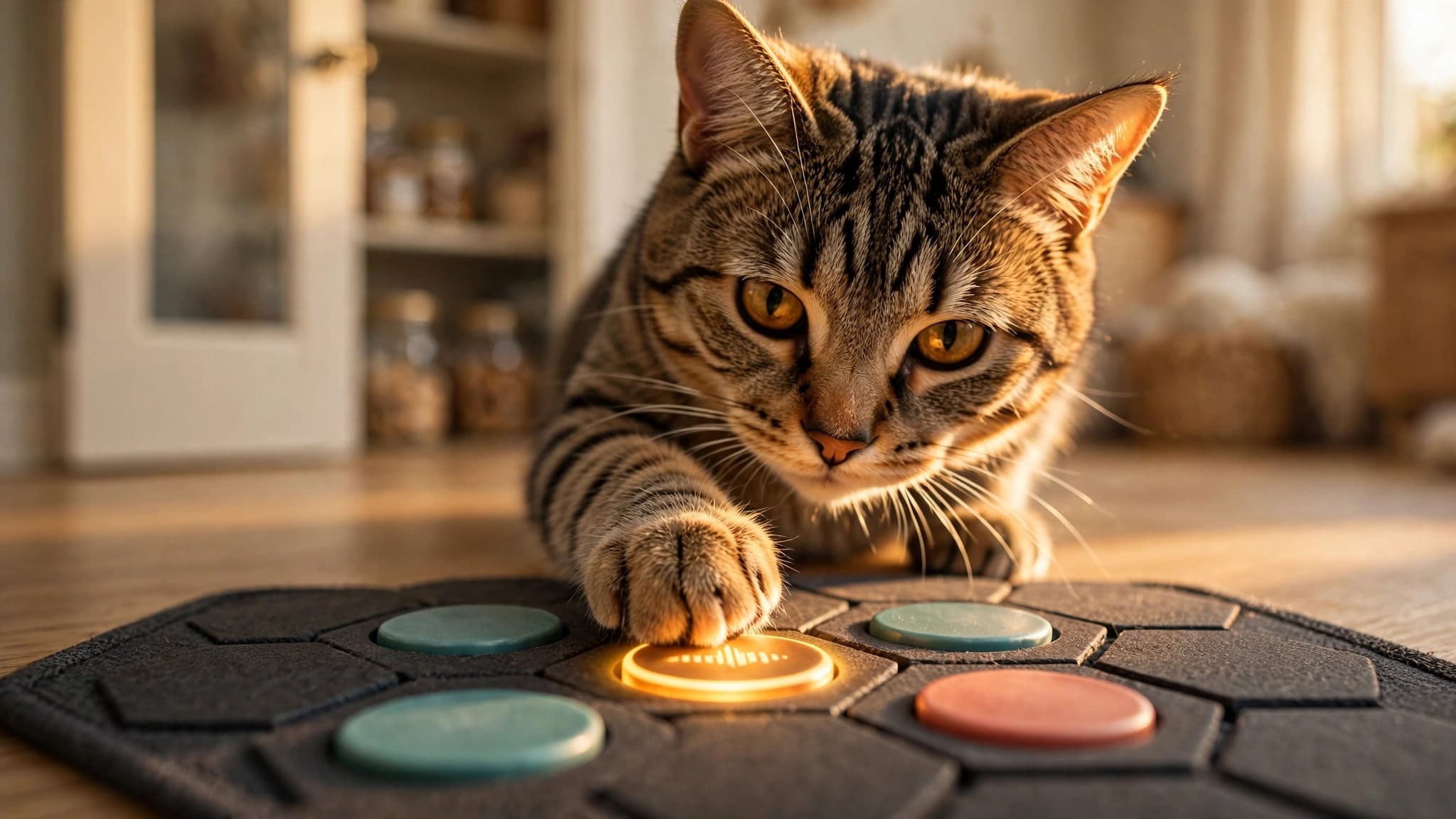
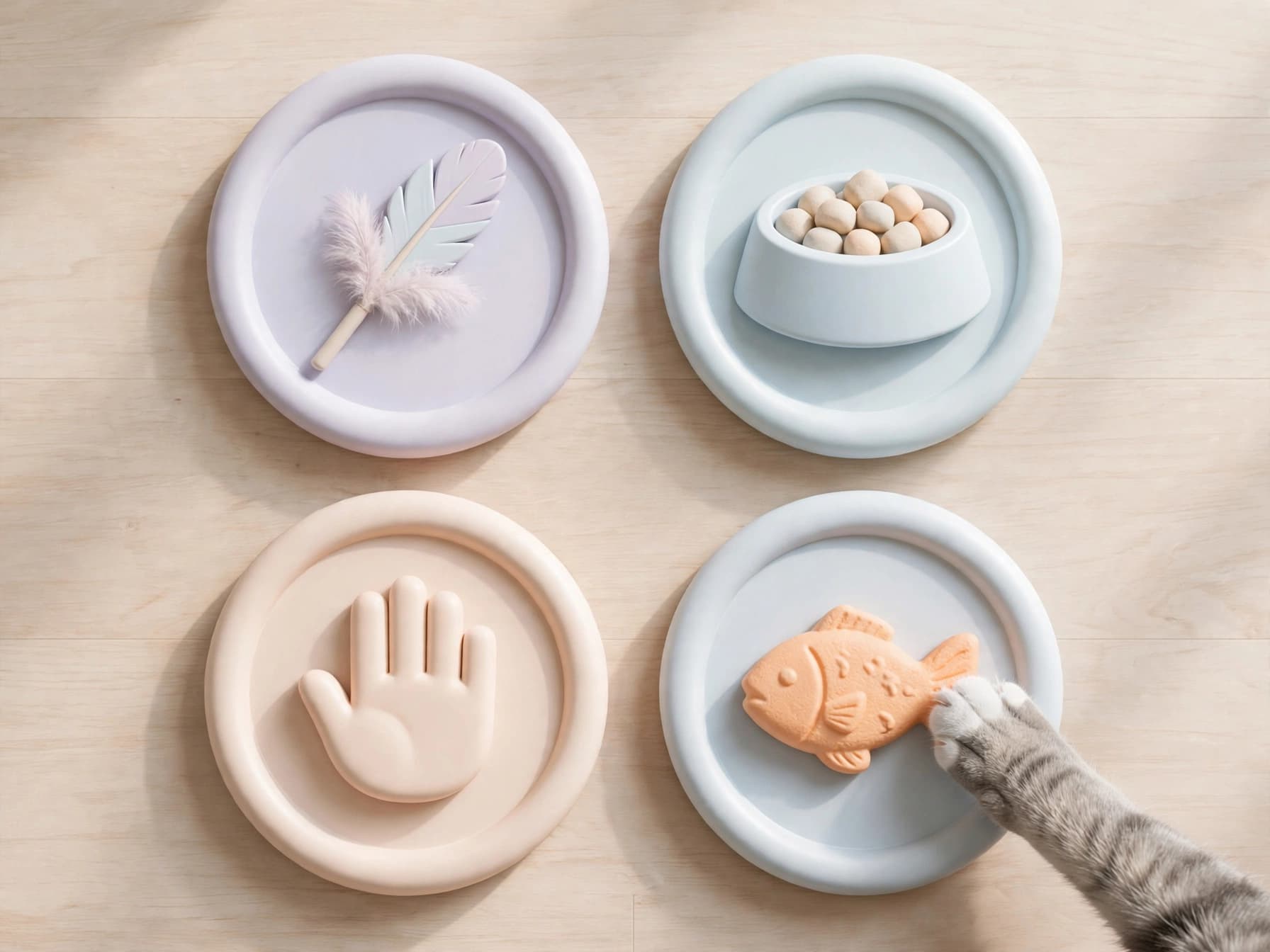
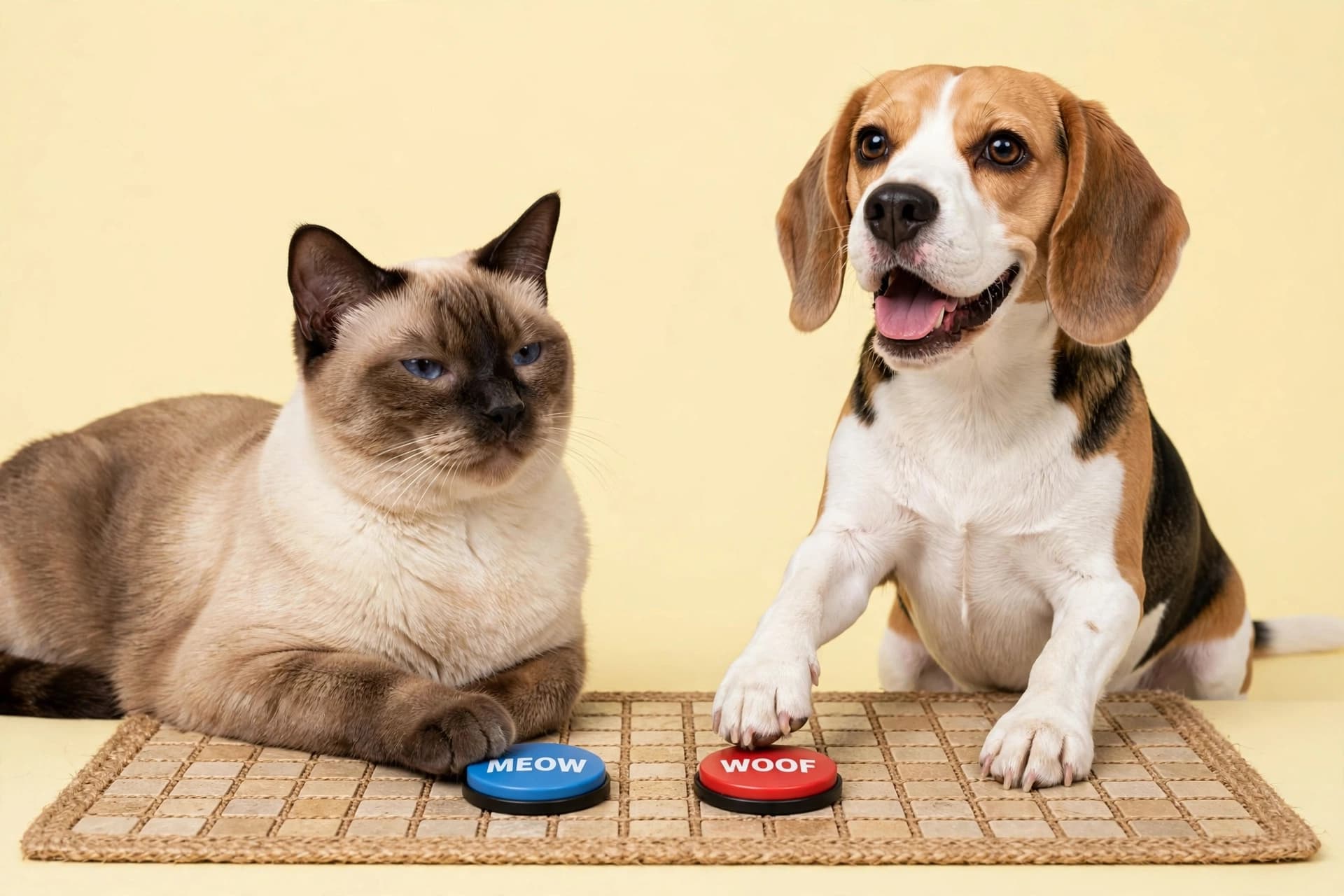
Sound buttons are uncomplicated. You pronounce a single word by yourself and the button repeats itself each time your cat triggers the button. Arrange a couple on a mat and you have formed a miniature soundboard which your cat can use to request something certain.
Cats already communicate the whole day. The tail posture, ear angle, slow blinking, and meows are all important (Source: American Association of Feline Practitioners / Cornell Feline Health Center guidance). Much of it is merely overlooked or misinterpreted by humans. A button provides your cat with a single, repeatable signal, and your easy method of responding.
An average installation consists of:
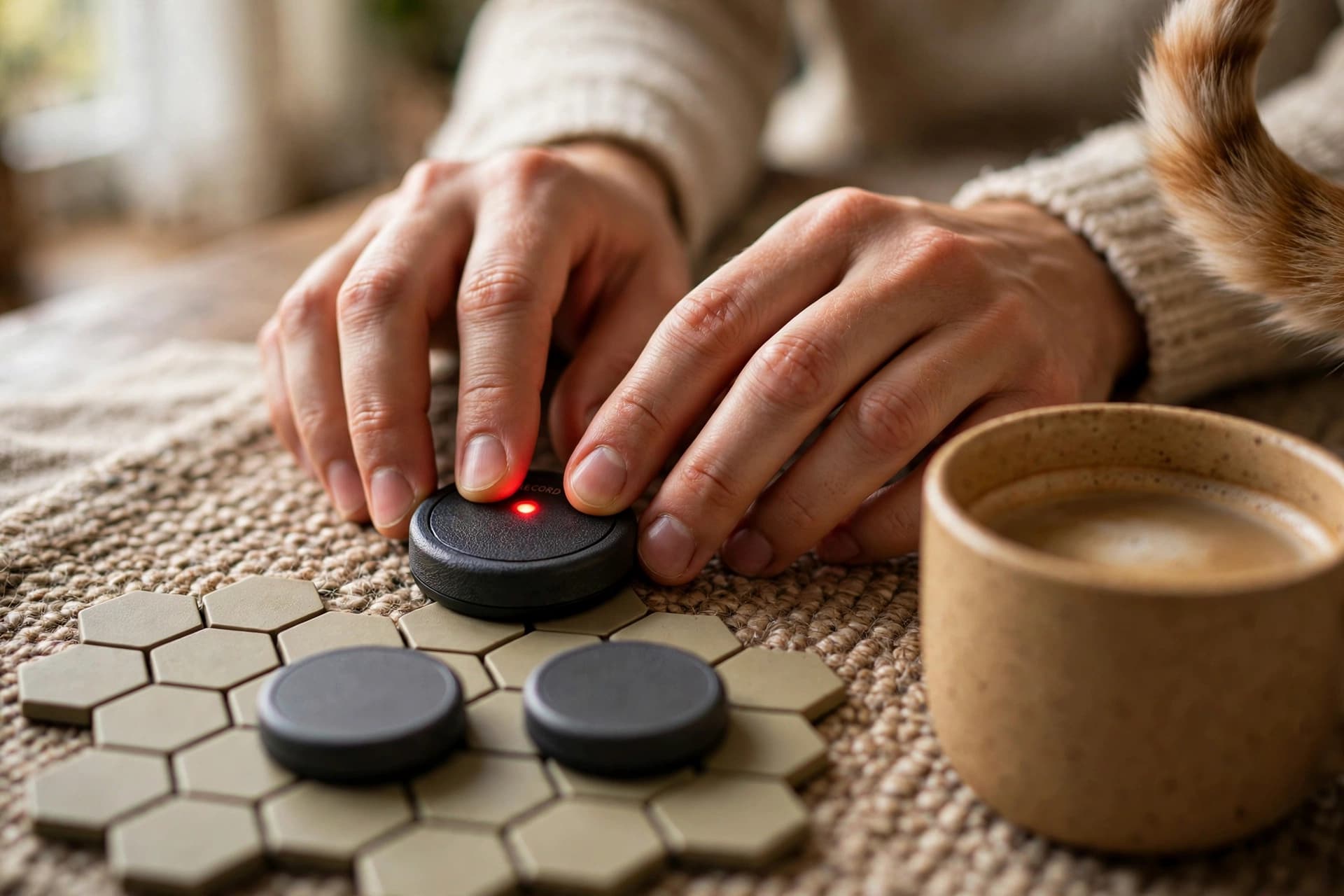
Recordable buttons: one word or short phrase in a time.
A non-slip mat/ tiles: to fix buttons and keep them in groups by topic. The HexTiles of FluentPet are made to do so (Source: FluentPet).
Smart locate: locate a play button close to the toy shelf, not the other side of the house.
Regularity: short sessions that are interspersed with daily life.
Price-wise, when we conducted a research on this we discovered that there was only one FluentPet at a price of $16 ( Source: FluentPet product page). Starter kits will be costly as they will comprise tiles and several buttons.
Do Talking Buttons Work for Cats? What the Research Says
The purpose of buttons is to enable a cat to request something that it already knows and it is clear that most cats learn that upon pressing a button something will happen. It is a more difficult question whether a cat acts like you do in regards to a button as a word. It is still under research.
What the Evidence Bears.
Regular scaling. The data of FluentPet is composed of about 610 cats, whose button preferences have patterns that are distinguishable and repeatable (Source: FluentPet).
Impressive outliers. Billi, a domestic shorthair, is said to have learned over 70 buttons ( Source: Salon coverage, as cited on Wikipedia). A Chicagocat, which was named Elsie, is reported to have learned over 120 (Source: New Statesman, as cited on Wikipedia).
Active research. The UC San Diego is not keen on disclosing the technique, although they employ observational data of pets that use buttons (Source: TheyCanTalk research page).
What It Doesn't Prove.
Human grammar. Even the introduction of FluentPet warns of using human grammar to a series of button presses ( Source: FluentPet).
Guaranteed success. According to one of the reviewers, in some instances two cats have struck a button by accident, but never on purpose, despite having ample opportunity to do so during their playtime (Source: LoveYourCat review, 2024).
Typical results. Famous cats are the majority of viral cats. The cat can be a typical user having three favorite words and that is also a win.
Justifiable conclusion is that buttons can be an enrichment and bonding experience worthwhile. Do not suppose a chat.
What Words Do Cats Learn First? The 50-Million-Press Data
FluentPet studied the button presses of more than 50 million dogs and 610 cats (Source: FluentPet). To define a real pattern and a cat playing with a new toy, they defined a first word as the first button that a pet pressed on 3 days.
The cats and dogs were compared in the following way:
Measure
Cats
Dogs
Pets analyzed
610 Approx
1,550 Approx
#1 first word
Treat
Outside
Next most common
Play, food, scritches
Play, treat, potty, food
Main theme
Food and play
Going out, play, food
About 5% of first three words of pets consisted of names such as "Mom" and "Dad" (Source: FluentPet).
Why "Treat" Leads
Payoff is the most probable explanation. A reward is fast, sweet and you can bring it to me with ease each time, thus the press-reward association comes easy. Cat early decision-making was also more centralized compared to that of dogs and food and play was the most popular decision-making (Source: FluentPet).
It has a snag, however. One of the reviewers notes that FluentPet does not encourage treat as the first word because it can teach a cat to believe that anything that is pressed can result in food (Source: LoveYourCat review, 2024). Go there, have a look at portions. The number of treats should not exceed one per ten calories of the day (Source: AAHA / veterinary nutrition guidance). How to do that safely is discussed in our treat portions and feeding guide.
Read the Numbers Carefully
This is not a controlled experiment, but information gathered by the company by the owners who decided to purchase and use the product. The results are also influenced by the choice of the words to model first thus what the cats desired and what humans taught. Take the ranking as a convenient halting place, not a law of feline nature.
FluentPet Cat Buttons: Setup, Cost, and Alternatives
The FluentPet brand is the most popular in this region. Its platform is a combination of recordable buttons and HexTiles and it comes with a free live Button Bootcamp, worth 40 dollars (Source: FluentPet). The company also operates an owner community where there are mentorship calls, such as ones targeting smaller learners such as cats.
You are not enclosed with a single brand. The owner of Billi, say, made a usage of the buttons of both Learning Resources and FluentPet (Source: Wikipedia summary of news coverage). The comparisons of the alternatives are the following:
Alternative
Best for
Trade-off
All-in-one kit (tiles + buttons + coaching)
Beginners who want a guided path
More initial expenditure
Personal recordable buttons
Test your cat interest
You will be required to have your own mat and layout
Mixed DIY installation
Less costly owners
More trial and error, less support
Prices are dynamic, so check up on current listings prior to purchase. Where to buy guides on our pet products and accessories track the accessories which are worth the money.
How to Teach a Cat to Use Talking Buttons: 6 Steps
Equipment is not the key to success, consistency is. Two or three buttons are the only possible recommendations made by FluentPet at the start as more buttons at once make it harder to learn the ideas (Source: FluentPet).
Select two or three first words. Choose things that your cat already prefers and that you can be trusted to give them such as play, food or a specific game.
Record clearly. The same calm voice and pronunciation should always be used and it should be restricted to one word.
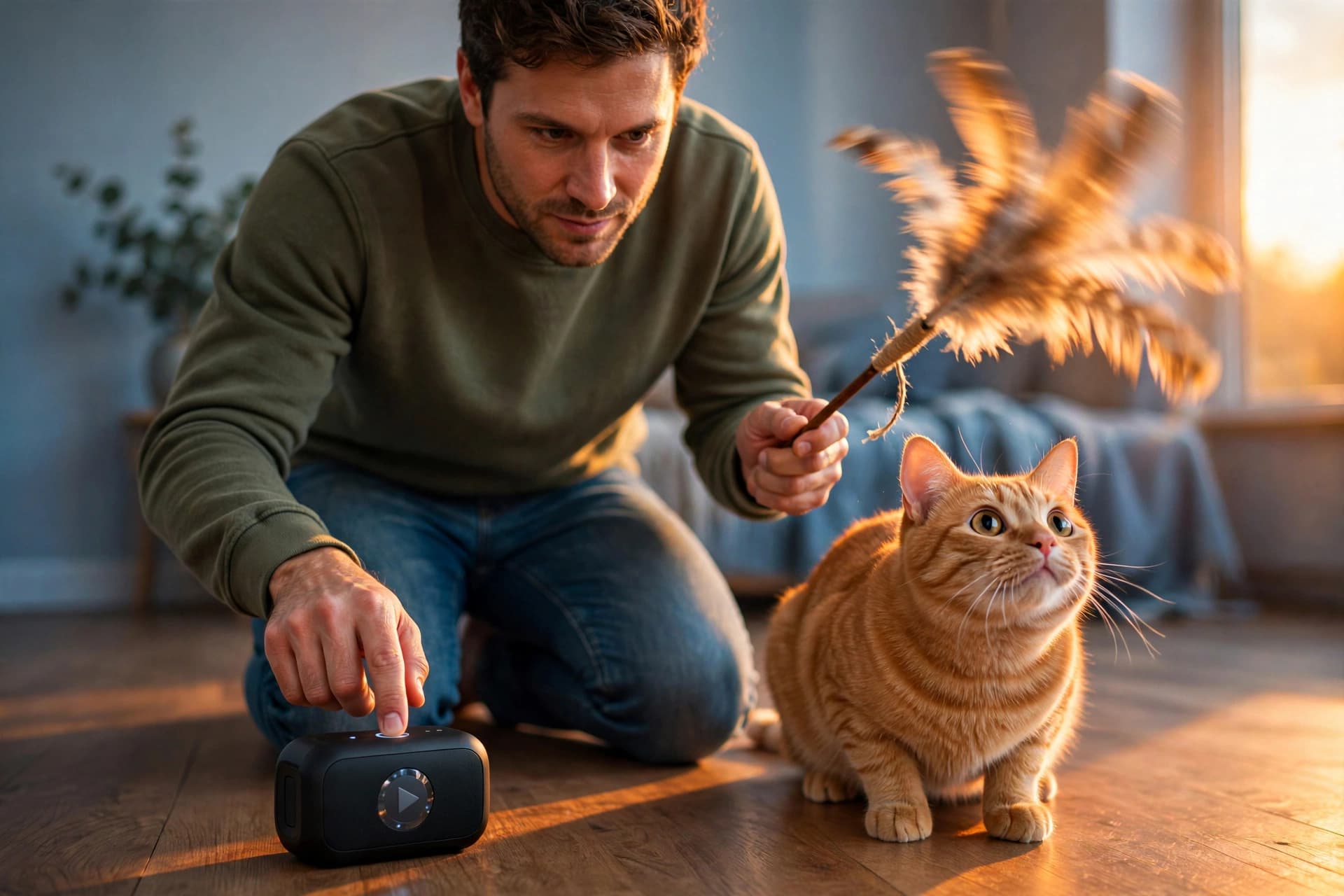
Place the action buttons in the place of action. Place the play button close to the toys, and the food button close to the bowl.
Model every time. Then do it with your own hand, pushing the button. Repeat for the first couple of weeks.
Reward any early presses. FluentPet underlines that presses need positive feedback including unintentional feedback (Source: FluentPet).
Add slowly. It is only with an intentional use of the words you have that you can bring in a new word.
Timing will be very variable. According to the testimonies of one of the owners, it took her cat nine months to press the first button independently, and then there was rapid development of the vocabulary ( Source: FluentPet customer account). You must first get into the habit before thinking of speed when it comes to cat ownership.
Mistakes That Stall Progress
Basically, over buttoning. Your cat will never associate one button with any meaning.
Inconsistent responses. The button is wasted when occasionally the play is not properly observed.
Expecting sentences. Most cats get great results when they are asked to react on single words.
Skip the health check. In case your cat suddenly demands food or water much more than you would think, then that is worth noting to your vet. What to watch for is explained in our pet health and wellness guides.
Cat Talking Buttons vs. Dog Buttons: Key Differences
The same tools are not made by animals like dogs and cats. The first dogs to respond to outside in the data of FluentPet to respond to the outside need to be connected with the walking-and-potty schedule, and the first cats to respond to the treat (Source: FluentPet). The vocabularies of dogs also disseminate to more daily needs.
Cats are picky about the times to play. They prefer to work at their own pace and therefore short sessions with low intensity normally outperform lengthy drills. One of the stories about Billi told that she was merely strung up with words less often than dogs in the same performance ( Source: Wikipedia summary of news coverage ) but a cat does not constitute a species.
We can use our dog care and training guides as a good point of entry into the other side of the comparison to dog owners interested in it.
In Conclusion:
"Get Small, Be Consistent."
The bigger lesson: Cats will insist on what they are already interested in and in a 50-million-press dataset, that was treats and playtime. All you require is two or three buttons and the ability to talk with a consistent voice, and to be patient everyday. Ready for more? The answer to these questions can be found on our cat care and cat behavior guide: Practical tips on reading the body language of your cat and add your own next word.
References
FluentPet, "First Words / 50 Million Buttons" data release, fluent.pet (press counts, ~1,550 dogs and ~610 cats, first-word definition, top words, names at ~5%, caution about human grammar)
FluentPet, "How to Choose Starting Buttons," fluent.pet (start with 2–3 buttons, early presses need positive responses)
FluentPet, Speak Up! Button product page and homepage, fluent.pet (button price, HexTiles, Button Bootcamp, customer account of nine months to first press)
TheyCanTalk, "Our Approach to Research," theycantalk.org (UC San Diego–affiliated observational research)
Salon, Nicole Karlis, December 12, 2021, article on Billi, and Wikipedia entries for "Billi (cat)" and "Elsie (cat)," which cite New Statesman coverage (reported vocabulary sizes)
LoveYourCat, "FluentPet For Cats Review," April 2024 (reviewer experience; manufacturer's reported advice on "treat")
Yes, it is possible to teach lots of cats to press a button and make a request of a specific kind, but the level of their understanding is debatable. The data of about 610 cats reported by their owners and the data of FluentPet indicate the permanence in the usage of such words as treat and play. Few studies on understanding of true words in cats are controlled.
What words do cats learn first?
Such first words as treat, play, food and scritches were the most common words used with cats, according to FluentPet analysis of about 610 cats. The first word was a first word that a cat pressed at least three days and was the first button that the company identified. The owners normally choose the first words and this may affect the results.
How to teach a cat to use talking buttons?
Begin by pressing two or three buttons (cats already like), and pressing each button right before the activity, and responding to it immediately. Repeat this every day at the shortest intervals until your cat insists. There are those cats that require weeks and others months, and thus, speed is not as crucial as patience.
Are cat communication buttons worth the money?
It may be worth it as long as you enjoy training your cat on a daily basis and you would like to have an additional activity in the life of your cat. A single button will cost around 16 dollars on the FluentPet site; therefore, a beginner set is more costly. The outcomes are varied, and therefore, start small and buy a big set.
How long does it take a cat to press a button on purpose?
It may take a number of weeks up to several months. One of the owners said that her cat had needed nine months to have the first independent press, followed by the rapid increase of vocabulary. This is likely to be hastened by short, daily-length sessions, regular responses, and a first word that is highly motivating.
Are FluentPet cat buttons the only option for cats?
No. There are other recordable sound buttons, and some are constructed by the owner using individual buttons and a mat. The system of FluentPet comes with HexTiles which is a free live Button Bootcamp, and an owner community. Whichever you choose, it is the recording and consistent practice which are important, rather than the brand.
Founder & Lead Pet Care WriterPeer-Reviewed & Tested
Written by Valentina Johnson
Valentina Johnson is a lifelong pet lover and writer who shares practical, easy to follow pet care tips for everyday owners. Her advice comes from years of raising her own pets, backed by real research and conversations with vets and trainers along the way. She's not a veterinarian, and always encourages readers to check in with one for anything serious. At the core of it all is one simple belief: every pet deserves a happy, healthy home.
Black cats get overlooked in shelters every year, thanks to old folklore and dark fur that's hard to photograph. Here's what the research really says, which myths to ignore, and a step-by-step plan for bringing one home this October.