It is Sunday, in January, and the furnace has been going weeks, and the windows have not opened since Halloween. Your dog is napping on the couch, your cat is on the bookshelf and the entire house has a faint scent of a wet retriever. Sound familiar? This guide will tell you what a home air cleaner can and cannot practically do to help your furry family, and how to make the most out of one.
Quick Answer: Yes, but with restrictions. The real HEPA unit collects the small flakes on the skin and floating fuzz that floating about your air, and that could make a difference to sneezing and stuffy noses. It won’t carry fur off your floors or clean the source of the smell and is best used together with normal cleaning.
Do Air Purifiers Remove Pet Hair From the Air?
It is a matter of weight, and partly. Fur that you have on the sofa is heavy, it falls on the floor a few seconds after you are shedding. In one corner stands a purifier, which draws in air in the vicinity, and thus it does not get a chance of majority of the air. According to the EPA, bigger particles fall out of the air almost instantly and are hardly ever to be found on a filter (Source: U.S. EPA).
What a purifier actually traps is the stuff you can not see: the lightweight fuzz, lint and dander, the tiny skin scales that your pet sheds every day that you can see with a microscope. Those particles are capable of floating up to hours and room to room. That is why your nose may misbehave even in such a situation when the house seems to be clean.
One out of every two-thirds of households in the US owns a pet (Source: American Pet Products Association) and thus many families breathe this on a daily basis. When you have a new pet, our new pet owner guides take you through the remainder of the setup.
A brief list of what a purifier can and cannot do is given here:
The Problem
What Causes It
Will a Purifier Help?
What Actually Fixes It
Fur on floors and furniture
Heavy shed hair that falls fast
Very little
Vacuuming and regular brushing
Floating fuzz and lint
Light undercoat and fabric fibers
Yes, mostly the pre-filter
Washable pre-filter, weekly cleaning
Dander
Tiny skin flakes carrying allergen proteins
Yes, a big help
Clean bedding, steady grooming
Odor
Urine, saliva, skin oils, litter
Only with a carbon filter
Clean the source first
Consider a purifier the cleaning team of what is floating, not a substitute to your vacuum.
HEPA Air Purifier for Pet Allergies: What It Can and Can’t Do
Surprise: people sneeze not because of fur itself. According to the Asthma and Allergy Foundation of America (Source: AAFA), the true triggers are proteins on the skin of a pet, saliva and urine. The proteins are ridden along by dander and other microscopic bits. This is why a filter that collects small particles is more important than the one that collects visible fluff.
What “True HEPA” Actually Means
The actual HEPA filter is constructed with the capability of capturing 99.97 percent of particles that are 0.3 microns in diameter (Source: U.S. Department of Energy HEPA standard). It is the largest size that a filter can easily get. Any bigger, as the majority of dander, becomes entangled even more readily.
Other labels that sound comparable but not offering similar performance include the label HEPA-type, HEPA-style, or 99% filtration. Unless the box indicates that it is true HEPA, shop on.
What to Expect for Your Symptoms
Improve, not cure. The consumer guide to home air cleaners created by EPA articulates that portable cleaners can reduce indoor pollution, but they cannot eliminate all the pollutants (Source: U.S. EPA).
Operate the unit 24 hours a day, since it does not clean any air outside of the unit. Others find it easier to wake up in the morning after several weeks, but with different outcomes. Talk to an allergist before altering your routine in case your symptoms are severe or even in case you have asthma.
Do Air Purifiers Help With Pet Odor? Where Carbon Filters Come In
Partially and only certain units. Gases, not particles, the odors do not get trapped by a HEPA filter but instead pass through it (Source: U.S. EPA). Activated carbon, a porous substance, is required to address smells, and the air passing over the activated carbon captures the odor.
Not All Carbon Filters Are Equal
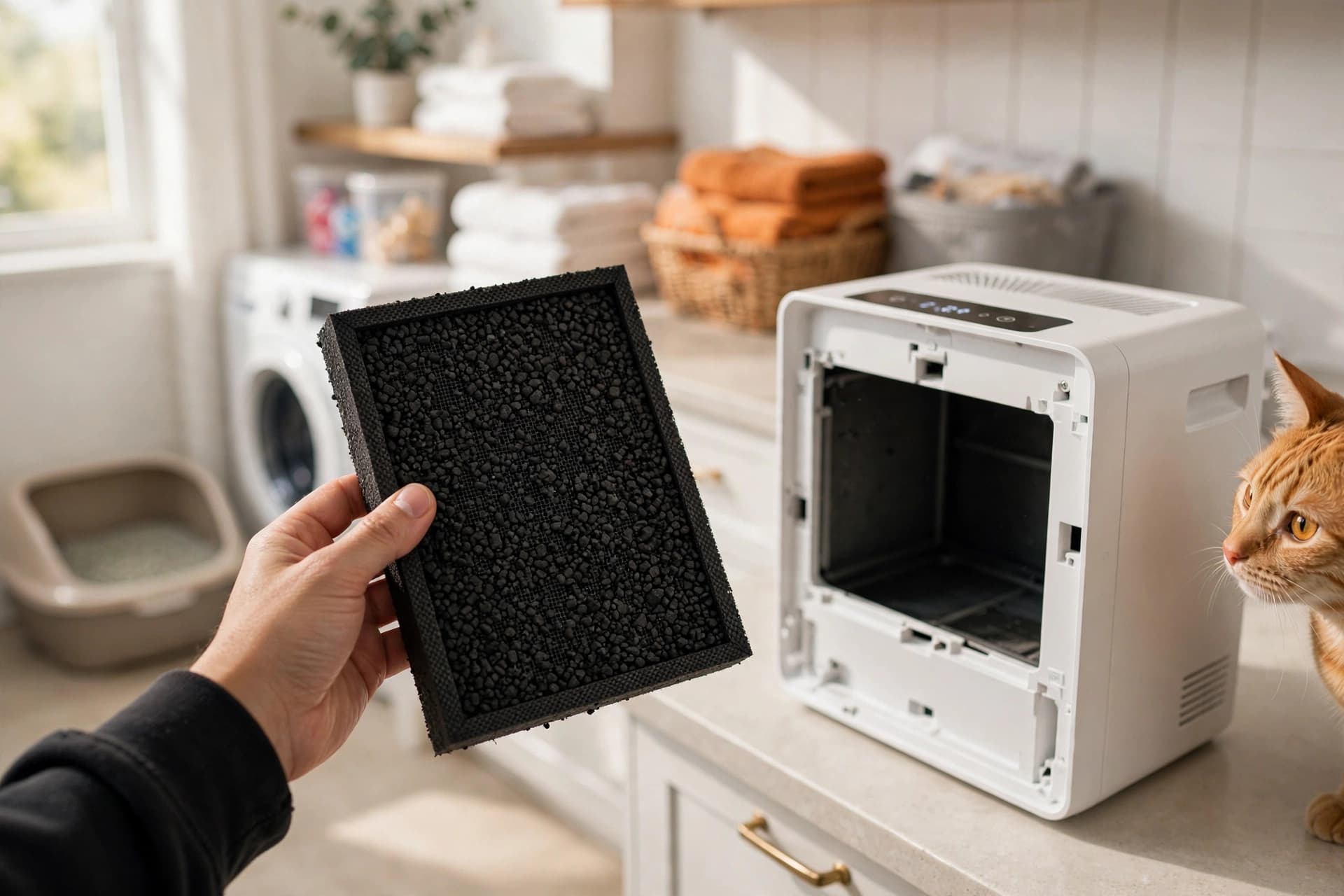
A lot of low-end models have a carbon sheet which is thin, lightly dusted, and ceases functioning in a few weeks. Seek a deep carbon bed, frequently quoted in weight, in pounds. Intend to replace after every 3 to 6 months (Source: typical manufacturer instructions).
Skip Ozone Generators
There are also devices that are marketed as odor eliminators and that intentionally generate ozone. The EPA justifies the reason ozone generators marketed as air cleaners are not a good buy, ozone is harmful to the lungs (Source: U.S. EPA). California also limits ozone emissions by air cleaners sold in the state, to a level of 0.050 parts per million (Source: California Air Resources Board).
Fix the Source First
The odors begin at the origin: litter boxes, wet dog bedding, and spills on the carpet. Wash bedding once a week, scoop every day and apply an enzyme cleaner on urine spots. Our cat behavior and care suggestions involve litter box systems that help in keeping the smells down.
Where to Place Air Purifier for Pets: Room-by-Room Tips
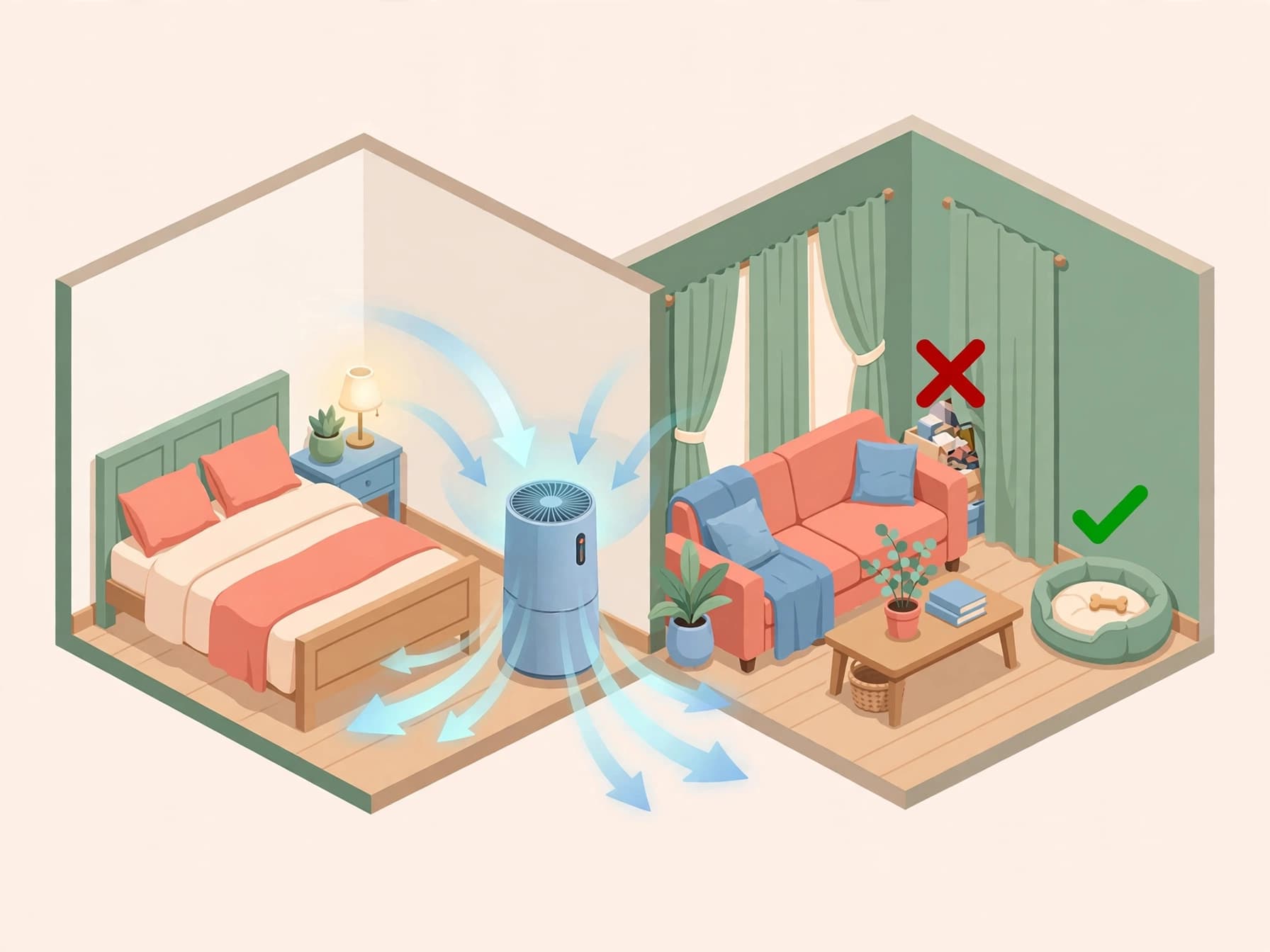
Placement is nearly as crucial as the model you purchase. A unit behind a couch or a covered curtain will not be able to draw in sufficient air to do its job. Follow these guidelines:
Bedroom first. You are there seven or nine hours a night. Place the unit next to your bed, and avoid pets on the mattress, as far as possible (Source: AAFA).
Living room next. Put it in the room in which your pet sleeps, in the side that has the most free area around it.
Don't crowd it. Keep space at all sides. The majority of manuals recommend several inches to a foot, so consult yours.
Keep doors and windows closed. Room-size ratings presuppose the use of a closed room (Source: Association of Home Appliance Manufacturers).
Keep away a few feet of the litter box. A filter can be plugged instantly by clumping litter dust, yet you want the unit present in the same room to be able to deal with odors.
Keep it running. Keep it on low throughout the day and turn it up during the times when you vacuum or groom.
How to Choose a Pet Air Purifier: CADR, Room Size, and Cost
Match the CADR to Your Room
CADR (Clean Air Delivery Rate) informs you about the rate at which a unit cleans the air. Check the AHAM Verifide label, indicating a tested rating.
The straightforward guideline of the industry is that you have to choose a unit that will have a smoke CADR of at least two-thirds of the square foot of your room (Source: AHAM). The size of a 12-by-15-foot room is 180 square feet, which means you would like the smoke CADR to be at least 120. Higher than 8 feet ceilings require a greater number. The AHAM Verifide directory will allow you to search models.
Features Worth Paying For
Indeed HEPA filtration of dander and microscopic particles.
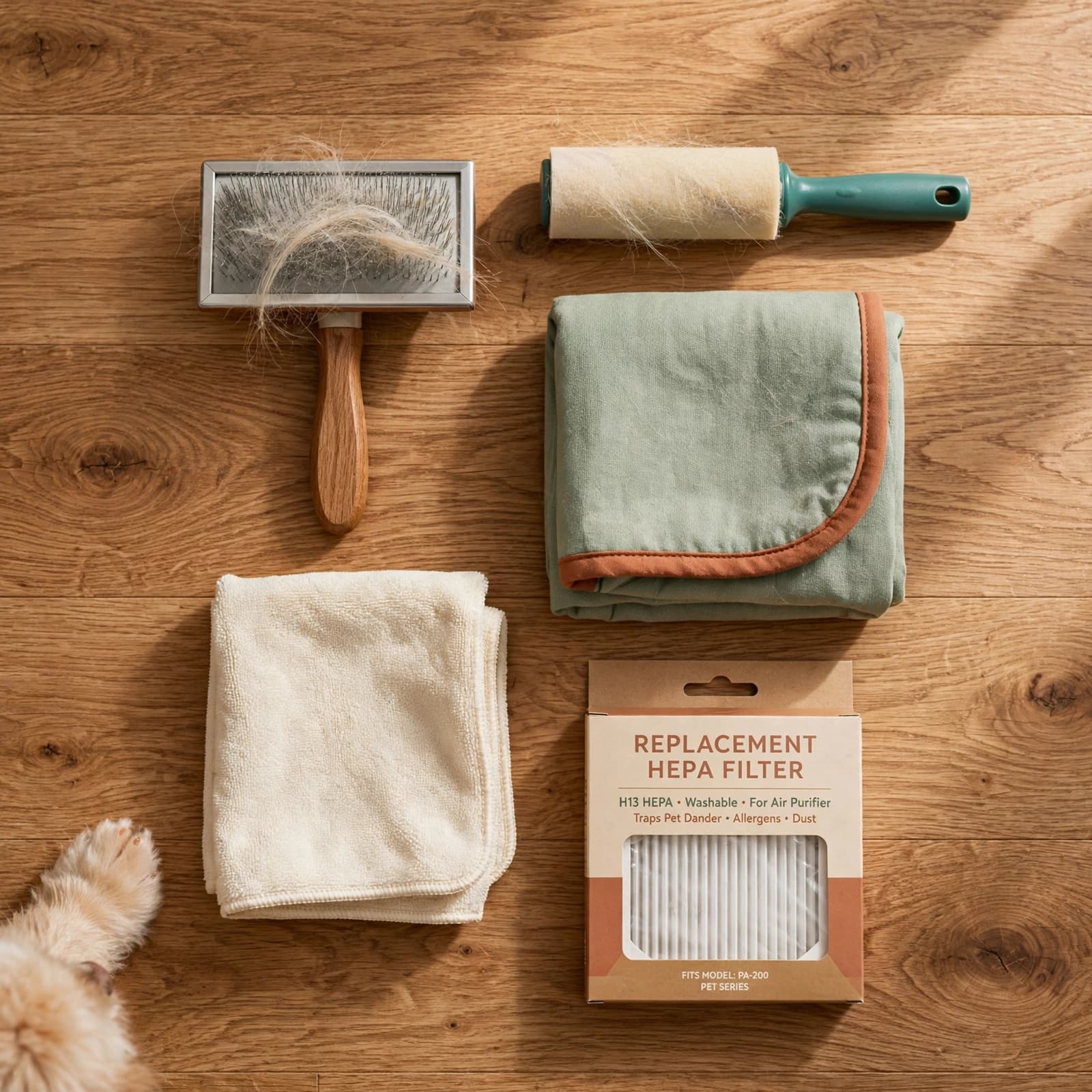
Pre-filter, which is washable, to remove fur and lint before they block the main filter.
Real carbon bed in case of smells.
Silent night mode so that you leave it on.
None of the ozone production, preferably with California Air Resources Board certification.
Replacement filters are readily available to prevent maintenance being a nightmare.
How to Reduce Pet Dander at Home Beyond the Purifier
Purifier does what floats. These habits dispose of what is accumulating:
Vacuum twice a week with a sealed-system vacuum that has a HEPA filter (Source: AAFA).
Wash bedding, blankets and throws weekly using only the hottest water the label on the care suggests (Source: AAFA).
Take your pet outside or in a carpetless room. Your vet will tell you how often to bathe, as excess bathing will only dry the skin and increase the number of flakes. Our grooming and hygiene guides take us through routines by the type of coat.
Clean surfaces using a damp microfiber cloth rather than dry dusting, which only spreads dust back into the air.
Where you can, wipe to hard floors and washable rugs. Carpet and upholstery is a sponge to dander.
Check your furnace filter. A more efficient filter, replaced 1-3 times per month, will be useful provided that your system is capable of it (Source: U.S. EPA and HVAC manufacturer guidance).
The Bottom Line:
A purifier will not get the fur off of your rug, but it can reduce the floating dander and smells that make a pet-filled home stuffy. Combine a real HEPA and carbon unit, regularly cleaning, smart positioning and regular grooming and you will inhale a bit easier without losing your best friend. Ready to take the next step? Browse through one of our pet health and wellness stories to maintain the entire family in good health.
References:
U.S. Environmental Protection Agency (EPA). Guide to Air Cleaners in the Home (2nd edition) and EPA guidance on ozone generators sold as air cleaners.
Asthma and Allergy Foundation of America (AAFA). Pet Allergy resources, including home-cleaning recommendations.
Association of Home Appliance Manufacturers (AHAM). AHAM Verifide program and room-size guidance.
U.S. Department of Energy. HEPA filter standard (DOE-STD-3020).
American Pet Products Association (APPA). National Pet Owners Survey.
California Air Resources Board (CARB). Air cleaner ozone emission limit (0.050 ppm).
U.S. Energy Information Administration (EIA). Average U.S. residential electricity prices.
Retail price ranges and typical manufacturer filter-replacement guidance. These are general market figures, so double-check them against current retailer listings before publishing.
Frequently Asked Questions
Do air purifiers help with pet hair and dander?
Yes, primarily because of dander and light fuzz, as a genuine HEPA filter will capture such floating particles, but the heavier fur would fall to the floor beforehand. Combine the unit with normal vacuuming and brushing to fill in the holes left by the filter and leave it running overnight.
Do air purifiers help with pet odor?
It can only work when the unit contains a thick activated carbon filter since HEPA on its own does not trap odor gases. Even at this time, a purifier simply lessens the odors, thus scoop litter, washing of bedding, and cleaning of pet accidents using an enzyme cleaner is the actual solution.
What should I look for in a HEPA air purifier for pet allergies?
Find a real HEPA filter, a smoke CADR to match the size of your room, and an AHAM Verifide seal, which verifies independent testing. Fur pre-filter must be washed and have a carbon layer over the pre-filter to remove the smell (although this is optional), but ozone-generating units should be avoided at all costs.
How to reduce pet dander at home without giving up your pet?
Take a combination of these little habits: vacuum every two weeks, wash your bedding once every week in hot water, brush your pet outside, and keep it off the bed. A real HEPA purifier in the bedroom will help remove the remaining airborne dust that remains in the air overnight.
How often do I need to replace the filters?
The life of most true HEPA filters is 6-12 months, whereas carbon filters frequently require replacement every 3-6 months. See your manual and replace at a younger age when you have multiple shedding pets, a dusty house, or the indicator light is turned on.
Are ozone air purifiers safe to use around pets?
No, they should be avoided, ozone is considered to irritate the lungs of the people and animals and the EPA suggests that air cleaners that deliberately produce ozone should be avoided. Easy safety check is to select a real HEPA unit and find certification by the California Air Resources Board.
Founder & Lead Pet Care WriterPeer-Reviewed & Tested
Written by Valentina Johnson
Valentina Johnson is a lifelong pet lover and writer who shares practical, easy to follow pet care tips for everyday owners. Her advice comes from years of raising her own pets, backed by real research and conversations with vets and trainers along the way. She's not a veterinarian, and always encourages readers to check in with one for anything serious. At the core of it all is one simple belief: every pet deserves a happy, healthy home.
Is an AirTag enough for your dog, or do you need a real GPS collar? We compare Fi, Life360, and AirTag on range, battery, and three-year cost to help you choose.